
At BeautyAnswered, we're committed to delivering accurate, trustworthy information. Our expert-authored content is rigorously fact-checked and sourced from credible authorities. Discover how we uphold the highest standards in providing you with reliable knowledge.
Is It Safe to Remove Skin Tags by Yourself?
It is possible to remove skin tags safely at home if the proper precautions are taken to prevent infections during or after a procedure. People may be able to remove the tumors by cutting them off, using a ligature to cut off blood flow or applying commercial liquid nitrogen. In general, however, a person should consult a trained dermatologist before trying to remove them. A medical professional can inspect problem areas carefully, ensure that other skin problems or medical conditions do not exist and recommend treatment options. If at-home removal methods are not effective, the next best option is receiving professional treatment at a dermatologist's office.
About Skin Tags

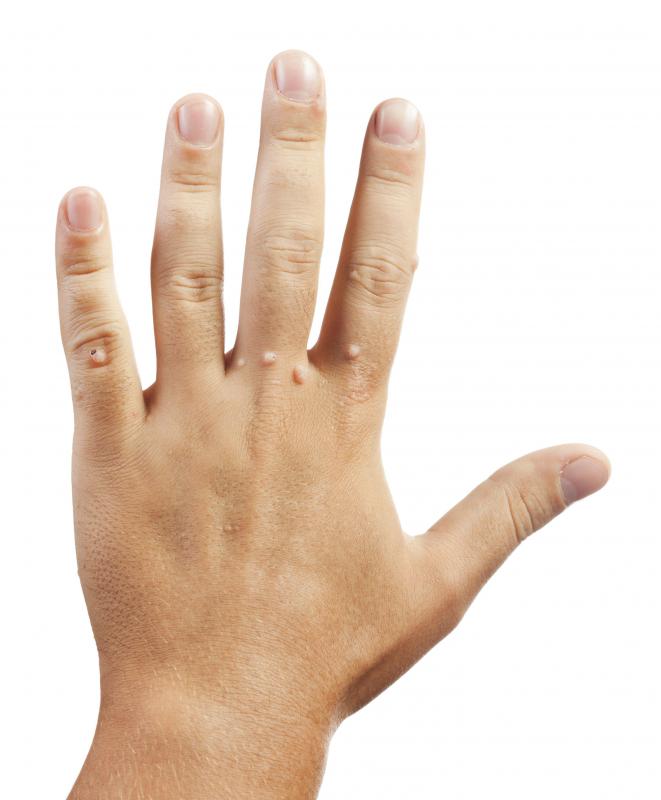
Skin tags are small, painless, benign tumors that appear as irregularly shaped bumps on the skin. They are small protrusions, usually no larger than a pencil eraser. Most people get tags in areas where the skin creases or folds, such as the armpits, neck, eyelids or groin. The cause of skin tags is largely unknown, but they appear most frequently in women, older people and individuals with diabetes.

These growths are completely harmless from a medical perspective. A person still might wish to remove them for aesthetic purposes, however, or to avoid accidentally irritating or cutting them by shaving. With the guidance of a dermatologist or primary care physician, people often can safely remove skin tags by themselves.
Cutting
An individual who takes care to prevent infections and accidents can cut off skin tags using a sharp scalpel or scissors. A person who wants to do this first should sterilize the skin and cutting tool with hydrogen peroxide or rubbing alcohol. One cut as close to the base of the tumor as possible is preferable. Any bleeding usually is controllable with cotton and a bandage.

An advantage of using this technique is that the results are very quick. The main disadvantage is that it can be painful, with the physical break in the skin providing a potential entryway for bacteria and viruses. Some people who have difficulty with the sight of blood also might not be able to perform this removal method on themselves.
Freezing
Many pharmacies and supermarkets sell over-the-counter, concentrated liquid nitrogen solutions that can be used to effectively freeze skin tags, warts, and other similar maladies. Most kits come with disposable applicators that freeze the protrusions on contact. This causes the cells to stop functioning and eventually erode.

Freezing a skin tag is beneficial in that it doesn't require any other tools aside from the nitrogen applicator. It does not physically break the skin, so there is no bleeding, and the risk of infection is very low. The drawback is that, depending on the size of the tag, it can take more than one application of nitrogen to freeze the growth completely. There is also some risk that a person accidentally will touch the nitrogen applicator to healthy skin, damaging it.
Ligation

Ligation is the process of binding something together. In medical contexts, it usually means to wrap something around body tissue to restrict or stop blood flow. This technique might work to remove a skin tag if the growth is large. To use this method, a person sanitizes both the skin and a piece of thin thread. He ties the thread tightly around the skin tag to restrict blood flow, which usually causes the growth to fall off in two to four days.

This is probably simplest means to remove skin tags. In order for it to work, however, the string needs to be very tight, and this can cause some discomfort. Bleeding still can sometimes happen, and similar to using nitrogen, ligation can take a while to be effective.
Herbal and Other Remedies
Some people recommend using herbal ointments such as DermaTend®. These are readily available in pharmacies and drug stores. Castor oil and baking soda paste, tea tree oil and apple cider vinegar also are said to be effective. The idea behind these solutions is that they essentially dry out the tag from the inside out, all while disinfecting it. Most of the evidence supporting these remedies is anecdotal.
Giving herbal remedies the benefit of the doubt, an advantage is that many of them use natural, non-toxic substances. Some people still can be sensitive to these natural products. The results, if any, happen slowly over time.
Location as a Factor in Removal Decisions
Assuming that a skin growth is not particularly big, the factor that is most important in deciding whether to remove it at home is the location of the tag. One that is located in the armpit, for example, can be extremely sensitive. In this case, it might be a better option to go to a doctor simply because he can provide a numbing agent or pain medication that is more effective than over-the-counter options. In the same way, a growth on the back can be difficult to reach without help, and one located anywhere near larger blood vessels might necessitate being in a location where professionals quickly can respond to heavy bleeding.
Consultation
When a person is not certain whether he should try to remove skin tags himself, it's always best to consult with a dermatologist or other professional. Through a basic examination, the professional can determine whether the size and location of the tag warrants removal in a medical setting. He might even be able to remove the tag in the same visit, depending on the method of removal he selects. Doctors use laser treatment, ligation, freezing, electrosurgery and scalpel cutting as removal methods.
AS FEATURED ON:
AS FEATURED ON:


-
![A sharp scalpel can be used to remove skin tags.]() By: iofotoA sharp scalpel can be used to remove skin tags.
By: iofotoA sharp scalpel can be used to remove skin tags. -
![Apple cider vinegar is a home remedy for skin tag removal.]() By: Comugnero SilvanaApple cider vinegar is a home remedy for skin tag removal.
By: Comugnero SilvanaApple cider vinegar is a home remedy for skin tag removal. -
![A skin tag.]()
A skin tag. -
![Some skin tags can be removed using liquid nitrogen.]() By: Gordon LauSome skin tags can be removed using liquid nitrogen.
By: Gordon LauSome skin tags can be removed using liquid nitrogen. -
![A doctor should be consulted following a skin tag removal if there is an infection or the tag returns in the same spot.]() By: ShakzuA doctor should be consulted following a skin tag removal if there is an infection or the tag returns in the same spot.
By: ShakzuA doctor should be consulted following a skin tag removal if there is an infection or the tag returns in the same spot. -
![Wart removal products may be used successfully on skin tags.]() By: Tiler84Wart removal products may be used successfully on skin tags.
By: Tiler84Wart removal products may be used successfully on skin tags.



Discussion Comments
No you cannot use the wart removers for skin tag removal. There is a product named dermatend that works for both skin tags and warts as well. But if you are looking for removing skin tags, then it is best to buy the product named revitol.
This post is going to be long! I have been reading a lot about skin tags since I had four: two small ones on my neck and two under my arms. I have been wanting to post here to share my experience and help others. Finally my tags fell off and I can now post. I had the tags for years and the ones under my arms were not that big, but were still very visible.
I decided to try tea tree oil treatment as I was too scared to remove them myself. I got Now Essentials 100 percent Tea Tree Oil and started the process. What I basically did was to make a small cotton ball from a bigger one and placing it on some tape, I would then add drops of tea tree oil on the cotton (the process seemed better because the cotton would stick). I then taped it and added two or three more tape pieces to secure it. The two small tags on my neck fell off in just three days. I didn’t have to cut or anything; they dried up so much that when I was cleaning after removing the tape, they came off painlessly.
My struggle started with the ones on my underarms, because they were bigger. I am thinking the bigger they are the longer they take, because they are stubborn and will do everything to survive. Think of it as a tick on a dog. Taping was particularly hard on my armpits because of the hair and sweat. I waxed, then started two days after. So, I did the same taping like I did on my neck and it didn’t seem to change in three days. Instead, it got bigger and painful! Like, really painful to even touch and it almost got to a size of a lentil or a pea. I didn’t know what was wrong until I noticed that the bottom of my tag was still the same color and hadn’t been affected because the cotton ball was placed over it. I then took a swab and cut a tiny piece and placed it under the tag and then did the same taping process and it started drying out and getting smaller. The skin came off easily.
On the fifth day, I just decided that I wanted to cut them out -- both of them -- and that was a mistake. I tried it on the smaller one and even after putting ice on it, it hurt like hell when I used clippers and made it worse. It bled and then it seemed like pus came out, but I was not giving up. I washed and cleaned the area I just took a big piece of swab and put some coconut oil on it and taped it for a day. The next day it was healed and I went back to tea tree oil. I was doing the same thing every day and within a week, one fell off. On the last day, it was just dried up completely and hanging and I tried to pull it, but it hurt, so I just decided to do one last day of tea tree taping and the next day it came off painlessly, while cleaning. The biggest one took the longest, but it was just two weeks altogether.
Tea tree oil does burn the skin, but mine healed quickly. I applied some argan oil every day on the affected area and it’s like nothing ever happened. It takes time, but it works. I always cleaned with alcohol and oil and the stickiness of the tape was hard to remove, but it worked. When the tags hurt, I was very careful and did as much as I could to clean them.
A few tips:
1. After a shower, wait for the skin to dry completely. Sit I front of a fan and it dries pretty quick, and then if you can get the fried skin off the tag, that’s the best thing. Don’t overdo it or try to hurt it. If it hurts, let it be and just tape it.
2. Use a good amount of tea tree oil. I used six or eight drops on my big one.
3. Tape it properly. I used about four pieces for one spot and while the first two were lightly pressed, I made sure the last two were tight and didn’t leave any room for it to grow.
4. Sometimes before taping I would drop some tea tree on the tag and clean the surrounding area.
5. Please don’t try to cut it if you know you won’t be able to do it. I have a low pain tolerance and my experience was like going through a hell of pain.
6. Use cheap tape. I got high quality and it just came off from the armpits, then I found two tape rolls for $3 at Target and it worked out miraculously.
7. Tea tree oil does cause skin tingling but it’s only for a few minutes. If you really want the tag to be gone in about two or three weeks, apply it every day. I had my moments when I was tired or saw no change. I took pictures to see change but didn’t see any, especially the first few days when it was growing and I thought that I made it worse, but I continued and it worked.
8. What you need to see is, no matter the size of the tag, the part that holds it from the skin -- the trunk sort of thing-- is getting smaller and if it’s getting bigger or small or changing color, the oil is definitely working. If you have way too sensitive skin, just mix tea tree with coconut or jojoba oil.
I wanted to share this because the last two weeks have been tough. I have been worried about the tags for years and years and even though these two weeks seemed like a long time, I am glad I am free of them. I would never let one grow that big again. I hope this helps someone, like the posts on this website helped me.
My friend told me of a natural way to remove skin tags using frankincense essential oil. She said to keep applying the oil until the skin tag falls off by itself.
I have not tried this myself yet, but she said she has had good results with this. I would be more apt to try something like this than cutting it off myself.
My husband has a large skin tag on his upper chest that he wants to remove himself, but I think this is too big to do at home. I would be afraid there would be too much bleeding and he would get an infection.
I think the best way to remove skin tags is have a doctor do it. I tried doing it myself once and ended up going to do the doctor anyway. I think it is best if you save yourself the time and trouble and let someone who really knows what they are doing deal with it.
I had one small skin tag under my arm and bought one of the kits at the drug store that had liquid nitrogen. This was such a small area that I thought I had nothing to lose by going this route first.
If I develop another skin tag I would use this again since I had such good results the first time. I know there is no way I could use the scissors method or remove it by tying a thread around it.
If the liquid nitrogen had not worked, I would have been making an appointment with my doctor.
I wanted to remove some skin tags on my neck but decided not to do it myself. I looked into the various options of removing them myself and felt a whole lot better about having a dermatologist do it.
She told me I would be surprised by the number of people who remove their own skin tags, but she thought it best if a doctor did it. For me it was worth the doctor visit to know it was being done the right way.
I did cut off a skin tag myself with a clean scissors at home. I did regret it later though because it bled a lot, much more than I expected. Thankfully, I didn't get an infection, I was just worried about the bleeding. It bled for a couple of minutes and finally stopped.
It also looked like I had a hole left behind where the skin tag was, not a pretty sight. I just cleaned it up, put antibiotic ointment on it and covered it. A scab formed on it and it slowly healed. But there is a tiny line there now where I had cut it off.
So technically, since I didn't get an infection, this was safe. It just really scared me for a while. I'm sure there are better skin tag removal remedies out there.
@ZipLine-- Yea, you don't need to cut anything off with the string method. The skin tag will fall off on its own if you tied the string correctly and tightly.
Basically what happens is that the blood supply to the skin tag will be cut off by the string (hence why it needs to be tight). After a day, you will see the skin tag changing color and the tissue slowly dying. Eventually, in several days, the tissue will have died and will shiver up and fall off on its own.
@anon124599-- Oh wow. I can't believe you did that. How much did it bleed? Did you get an infection?
I have a small skin tag on my stomach. I have heard about the string method before from a friend. I want to try this skin tag removal at home but I'm too scared.
But why did you cut the skin tag after using string? Isn't the skin tag supposed to fall off on its own in a few days?
I'm okay with tying string around it, but I don't think I can get myself to cut it off like that. I'm sure it will get infected.
I just used the string and scissor method. the hardest part was tying the sting around it because of the location (under my bicep). Just make sure you have sharp and clean scissors and just cut it, painless and effective. It will bleed
A lot of people underestimate the need for medical help when it comes to skin tags, especially when the tag occurs on the face or especially near the eyes.
Skin tag removal hardly counts as major surgery or anything, but it can be difficult to achieve complete sterility without some intense research and effort. The amount of blood that a snipped off skin tag can produce can also surprise some people.
Skin tags often get a tiny artery giving their blood supply, and that little artery can bleed for quite some time before finally clotting up. I'm not saying that you should give your doctor money when you can do it yourself, I'm just saying that it pays to know exactly what you're in for. --Donald
@christym: From what I’ve read, the wart remover is not effective for skin tag removal. As the article stated, liquid nitrogen is common treatment for skin growths. The liquid nitrogen destroys the cell tissue quickly and effectively.
The liquid nitrogen should not be applied in the same area more than once a week.
If the skin tags are large, I would recommend seeing a dermatologist and getting them removed in the office.
Can you use wart remover for skin tags? Are there other skin tag removal products?
Post your comments